Showing posts with label Kagame President. Show all posts

Saturday, 6 October 2012

Britain under pressure to end all aid to Rwandan government


By , Investigations Editor
9:00PM BST 06 Oct 2012

Britain is under mounting international pressure to stop all aid to the Rwandan government.

Rwanda’s President Paul Kagame, Britain’s Minister for International Development Andrew Mitchell and Uganda’s President Yoweri Museveni talk in Kigali Photo: REUTERS
The United Nations and the European Union wants the UK to withhold millions of pounds it is due to hand to President Paul Kagame’s government as part of an international campaign to choke his regime of funds.
Rwanda is accused of arming rebels responsible for atrocities, including mass rape, in the neighbouring Democrat Republic of Congo.
They hope that Britain will fall in line after David Cameron replaced Andrew Mitchell as international development secretary in his Cabinet reshuffle last month.
Britain initially agreed to go along with international condemnation of Rwandan involvement and to cancel £83 million it gives it in aid each year.
But Mr Mitchell’s last act in the job, before he was moved to the role of Chief Whip, had been to restore about £8m aid to the regime, with another £8m to follow later this year, apparently against the advice of officials in his department and from the Foreign Office.
He based the decision on personal assurances from the Rwandan president and on his own experiences running a small Conservative “charity” project in the country.
Officials were told his personal experience with Project Umubano outweighed evidence from a group of experts from the UN, Human Rights Watch observers and Foreign Office officials.
The Sunday Telegraph has learned that the UN and EU privately expressed their “disappointment” with Mr Mitchell’s decision at a hastily convened international contact group meeting at the Foreign Office last month.
A source at the meeting said there were “obvious differences” between Foreign Office officials and “between different officials in the Department for International Development”.
Mr Mitchell apparently also ignored police intelligence reports that suggest Rwandan dissidents living in exile in Britain are being targeted by the regime.
Last year the Metropolitan Police took the unusual step of issuing the Rwandan exiles with formal warning notices stating that “the Rwandan government poses an imminent threat to your life”.
The United Nations and Europe have both accused President Kagame of giving support and weapons to the so-called 23 March Movement (known as M23) in the Democrat Republic of Congo, accusing it of attacking civilians and “acts of sexual violence”.
At a meeting at the UN in New York last week the EU directly accused Rwanda of backing the M23 rebels. President Kagame and senior figures in his regime may now face sanctions over their links to the group and human rights abuses it has carried out.
Two new confidential reports on Rwanda’s involvement with the M23 rebels were presented to Security Council officials last week and are likely to lead to further action being taken against the regime at the UN in the next few weeks.
A UN source said: “Britain’s position has come as a bit of a disappointment to those who are trying to alter the position on the ground. Everyone else is united in putting pressure on Rwanda.”
Britain is Rwanda’s largest aid contributor and the source said its involvement in bring pressure to bear on President Kagame was “vitally important”.
Internal documents from DfID, released under the Freedlom of Information Act, reveal that in a February 2011 telephone conversation, Mr Mitchell had promised the Rwandan president that Britain would increase its aid from £60m to £90m by 2015. Two months earlier, he had flown to Rwanda for a “90-minute tete-a-tete followed by lunch” with the newly re-elected president.
But the memos also reveal doubts within the department about the “political risk” in Rwanda. Mr Mitchell’s ministerial colleague, Stephen O’Brien, highlighted international concern about human rights in Rwanda.
Justine Greening, the new International Development Secretary, must now decide whether Rwanda should receive the second tranche of the money promised by Mr Mitchell. Her office did not respond to requests for comment last night.
It is understood that Mr Mitchell based his decision to continue aiding Rwanda on “personal assurances” from Mr Kagame who had previously attended the Conservative conference and lavished praise on Project Umubano calling it an “unprecedented” example of aid. He is also understood to claim, though, that the decision was later agreed by Downing Street.
The Conservatives’ Rwanda project was Mr Mitchell’s personal brainchild but was designed to show the caring side of Mr Cameron’s Party when it was in opposition.
Now also working in Sierra Leone, the project has seen more than 200 Tory supporters, including Mr Mitchell, his wife Sharon and their daughter Rosie, fly to Rwanda for two-week stints to help as the country slowly recovers from the genocide which saw an estimated 800,000 people murdered there in 1994.
Mrs Mitchell, a GP, has also spent several months working as a doctor in Rwanda.
The Prime Minister praised the project as “the first time that any British political party had engaged in a social action project in the developing world”.
He said he and Mr Mitchell had set it up “to raise awareness of global poverty and play a small part in tackling it on the front line”.
Yesterday a Conservative spokeswoman said the project, which includes an annual Tories versus locals cricket match, had “provided English lessons to over 3,000 Rwandan primary school teachers, renovated a school, established a small medical library and built a community centre”.
Conservative volunteers, including ministers, MPs, Parliamentary candidates and local councillors, pay their own airfares, but much of the start up money for the project came from a wealthy widow from Hove, Helena Frost.
Despite having little interest in politics, according to her family, Mr Mitchell personally persuaded Mrs Frost to provide the funding. Electoral Commission files show that before her death last November, she gave the party £250,000 in donations – £200,000 of which went to fund Mr Mitchell’s office in opposition and £50,000 directly to the Rwanda project.
Last night, Mrs Frost’s nephew Mark, who was close to his aunt and often accompanied her to charitable events, said he was “slightly taken aback” that she gave so much.
He said: “It would appear Mr Mitchell (was) very charming and very persuasive. It was quite a large sum which doesn’t necessarily seem to fit with the amounts she ordinarily gave to the many other charities she supported.
“She was not one to meddle in politics at all and was convinced the money was going to help the poor. She would have not have given money to politicians for political use or gain, she had understood that she was helping the poor in Rwanda.”
He added: “This was a private matter and she was reticent about this particular charitable donation.
“She was a wonderful woman who had a great passion for certain causes and for many people. I can only imagine that this may have been the case on this particular case for her to have contributed such large sums to a single cause.”
He said Mr Mitchell had been introduced to her through another charity that he was involved with and to which Mrs Frost, who had a considerable personal fortune and had also set up a £6 million charitable foundation in the name of her late husband Patrick, had contributed large sums.

Source: The Telegraph
Wednesday, 26 September 2012

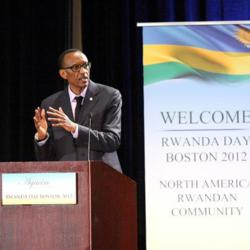
Rwanda Day 2012: When Rwandans spoke directly to the World


President Kagame said that the crisis in the Democratic Republic of Congo is the failure on the part of the Congolese leadership and the international community. Rwanda has contested the contents of three UN reports that have been published in the past months alleging Kigali’s link to the conflict in eastern DRC. “We are the top beneficiaries of peace and stability of the same peace in Congo, we can’t invest in war,” said Kagame. “Rwanda has been pushing more than others to have successful integration in the region…We can't be people who benefit most from peace in the region whilst investing in destabilising the same region.” reports newsofrwanda.com from Boston as part of Rwanda Day 2012


Boston,Massachusetts (PRWEB) September 26, 2012
President Kagame addressing the event

In June last year, US civil rights activist Rev. Jesse Jackson moved up the podium to introduce President Paul Kagame at what had been dubbed ‘Rwanda Day’ event in downtown Chicago. He was part of a long list of global names that joined Rwandans in North American to connect with those back home.
For the second year in a row, this time September 22-23, 2012, thousands of Rwandans and friends of Rwanda descended on Boston, Massachusetts. The event was intended as a celebration of Rwandan culture, along with the economic and social progress being made in the past 18 years.
Boston’s 10 Huntington avenue was all gleaming with brand Rwanda over during the weeks leading up to the D-day. And when it came, inside the Westin Copley arena, thousands of Rwandan Diasporacheered and danced at the two-day event. On Sunday afternoon, guest speaker President Kagame was received with applause – a show of the audience’s trust in his work in transforming their homeland.
“We should not allow anybody to define us without us…” he said in an unscripted speech, only depending on prepared notes . “We have to look for solutions in us; we have abilities we are not aware of unless we try.” President Kagame said that the responsibility to build Rwanda squarely rested on the shoulders of Rwandans, both at home and abroad.
“Did you know..?”
He told the Diaspora community that Rwandans back home were working hard, individually and collectively, to better their lives. Rwandans needed to tell their story, or somebody else twisted it to suit their agenda, said the President.
“Did you know…” he said, that Rwanda had been rated as the third most competitive country on the African continent and remains top in the east Africa region, according to the World Economic Forum.
“Did you know…” added the President, Rwanda has became the world’s admiration for its tough stance on corruption. Anti-graft group ‘Transparency International’ ranks Rwanda far ahead in comparing kickbacks and bribery compared to none of its regional and continental neighbours.
The statistics show 42% Ugandans viewing their country as prone with corruption. In Tanzania, prevalence is 39.1%, Kenya with 29.5% and Burundi with 18.8% – as compared to Rwanda having only 2.5 percent. Even among this figure, they had not directly faced graft; as the report puts it.
DRC not Rwanda’s problem
President Kagame said that the crisis in the Democratic Republic of Congo is the failure on the part of the Congolese leadership and the international community. Rwanda has contested the contents of three UN reports that have been published in the past months alleging Kigali’s link to the conflict in eastern DRC.
“We are the top beneficiaries of peace and stability of the same peace in Congo, we can’t invest in war,” said Kagame. “Rwanda has been pushing more than others to have successful integration in the region…We can’t be people who benefit most from peace in the region whilst investing in destabilising the same region.”
The President said the origins of the conflict ravaging eastern DRC precedes generations before himself and everybody inside the Rwanda Day venue. “Some people are innocently ignorant about the crisis on that country because they are reading more about Rwanda than Congo itself,” added Kagame.
Town hall-style discussion
Rwanda Day 2012 had the theme: ‘AGACIRO, THE JOURNEY CONTINUES’, that aimed at reminding Rwanda’s Diasporas to focus on the better future with the rest of their countrymen and women back home. The Rwanda Day North America was for the first time held in Chicago City – the State of Illinois (USA), and a similar event in Paris for Rwandan Diaspora in Europe.
At the 2012 session, those attending had the opportunity to speak directly to President Kagame in a town hall-style discussion. A group of Pan African academic organisations representing various academic and faith-based organisations awarded the President with a ‘Commendation’ – describing him as a true African.
A Rwandan female designer based in Boston presented the President with a designer T-shirt inscribed with the President’s image. Another Rwandan woman said she had expertise in helping children with special needs, and was seeking to know the government’s policy framework regarding these children.
Friends of Rwanda, who are ordinary individuals and senior citizens in their countries, were also at the event. A Ugandan, Charles Kirumira, who owns an IT company in Rwanda narrated that he tried but failed for six months to open a business in his country. When he tried Rwanda, the business was already on the books in two days.
A Singaporean businessman said he travelled all the way to attend the event. As for, Abdulahi, a Senegalese living in Canada, all he could say was that he loves Rwanda and its culture.
Opening session
On day One, opened by Foreign Affairs Minister Louise Mushikiwabo, different activities were showcased. Sky Miller, who represented many friends of Rwanda in the gathering, said that Rwanda has become famous in the world due to remarkable and fast development and good governance over the last 18 years.
Sky Miller also noted that Rwanda’s Diasporas are one of the country’s greatest assets to be relied upon as they focus on the future.
The event enhanced several exhibitions from Rwanda brought by companies both governmental and private, showcasing products and services to stress on the country’s economic reform while revealing development steps taken.
Some of the companies involved in the display were: Rwanda Development Board (RDB), Rwanda Mountain Tea, Inyange Industries, Rwanda Development Bank (BRD) Bank of Kigali (Bk), and other many local investors; a launching that was done by the country’s Minister for Foreign Affairs and Cooperation Luis Mushikiwabo in the presence of some other cabinet members.
The hope of Rwanda, economic strategies and advancement both in social and political areas continue to astonish the world as most countries wonder how this could have been archived.
Rwanda is now the first country in Africa’s great lakes region to have established the new world class Cancer Center of Excellence which is also the first comprehensive cancer referral facility housed in Butaro Hospital, (one of high ranking hospitals in the world) situated in Northern Province of the country.
Another striking achievement is a programme, One Laptop per Child (OLPC) which has distributed more than 115,000 laptops in 227 primary schools; and is considered the most successful primary school programmes in Africa. Rwandans did not speak to the World only in words but the country continues to tell the International community that commitments are the Africa’s solution.
Source: PRWeb